From Bench to Bedside: A Practical Guide to Using Large Language Models in Medical Research
Large Language Models (LLMs)—exemplified by frontier systems like GPT-5, Claude 4.5, Gemini 3, Llama 4, and DeepSeek-R1—are no longer just objects of computer science curiosity. They represent a transformative class of artificial intelligence tools that are actively reshaping healthcare and medical research, with applications spanning clinical documentation, automated trial matching, and medical question-answering.
However, simple ad-hoc prompting (e.g., typing raw questions into a public chatbot) is far from sufficient for high-stakes medical workflows. To bridge this gap, a multi-institutional team of researchers (Jin et al., 2026) published a landmark tutorial in Nature Protocols outline a structured, five-phase methodology for implementing LLMs in medical settings. In this tutorial post, we break down their actionable best practices from task formulation to clinical deployment.
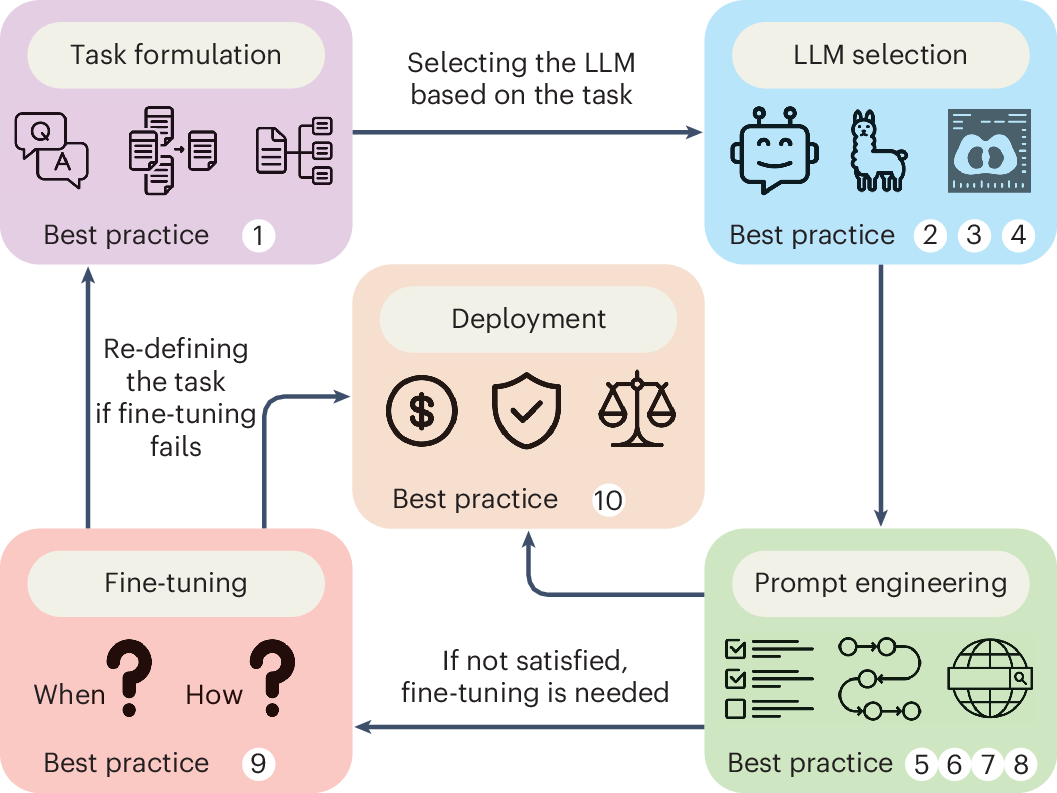
1. The Five Core Medical Task Formulations
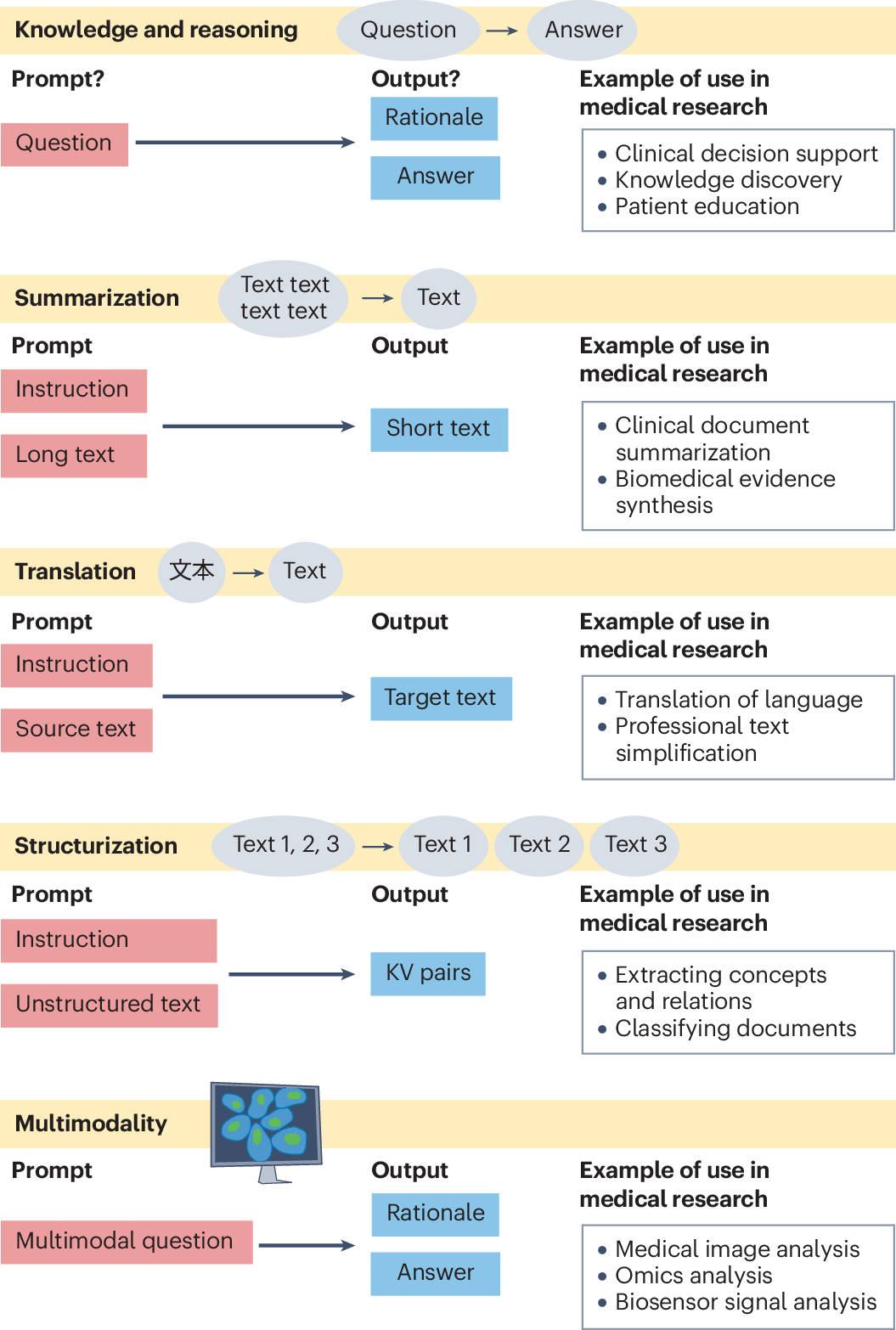
Before selecting a model or writing a prompt, you must formulate your abstract medical need into a concrete computational task. The Nature Protocols framework classifies medical LLM capabilities into five categories:
A. Knowledge and Reasoning
LLMs leverage medical knowledge encoded in their parameters to perform domain-specific reasoning.
- Applications: Clinical decision support, medical question answering, diagnostic differential generator.
- Format: Instances consist of a clinical scenario/question (Input), a detailed rationale or explanation (Context Output), and a final short answer (Output).
- Evaluation: Exact matching (for multiple-choice or yes/no answers) followed by expert rubric-based evaluations of the rationales.
B. Summarization
Condensing verbose medical text into concise, actionable summaries while preserving critical clinical facts.
- Applications: Generating progress notes or discharge summaries from raw EHR charts, systematic evidence synthesis from medical literature.
- Format: Instructions and original long text (Input) paired with the summary (Output).
- Evaluation: Automatic n-gram overlap metrics (BLEU, ROUGE, BERTScore) followed by physician-adjudicated review for hallucinations.
C. Translation
Translating text across natural languages or transforming medical jargon into patient-friendly language.
- Applications: Multilingual healthcare delivery, patient education, professional consent simplification.
- Format: Instruction and source jargon (Input) paired with target text (Output).
D. Structurization
Transforming unstructured clinical narratives into structured databases (e.g., JSON or key-value pairs).
- Applications: Information extraction (e.g., variant-disease relationships, side effects), classifying patients into Diagnosis-Related Groups (DRGs).
- Format: Instruction and unstructured text (Input) paired with structured values (Output).
- Evaluation: Standard classification metrics (Precision, Recall, F1-score).
E. Multimodal Data Analysis
Integrating and reasoning across heterogeneous clinical modalities.
- Applications: Generating radiology impressions from scans, predicting genomic outcomes from DNA sequences, and time-series vital sign analysis.
- Format: Inputs contain multimodal data (e.g., text history + medical images) paired with the report (Output).
2. Choosing the Right LLM: Core Considerations
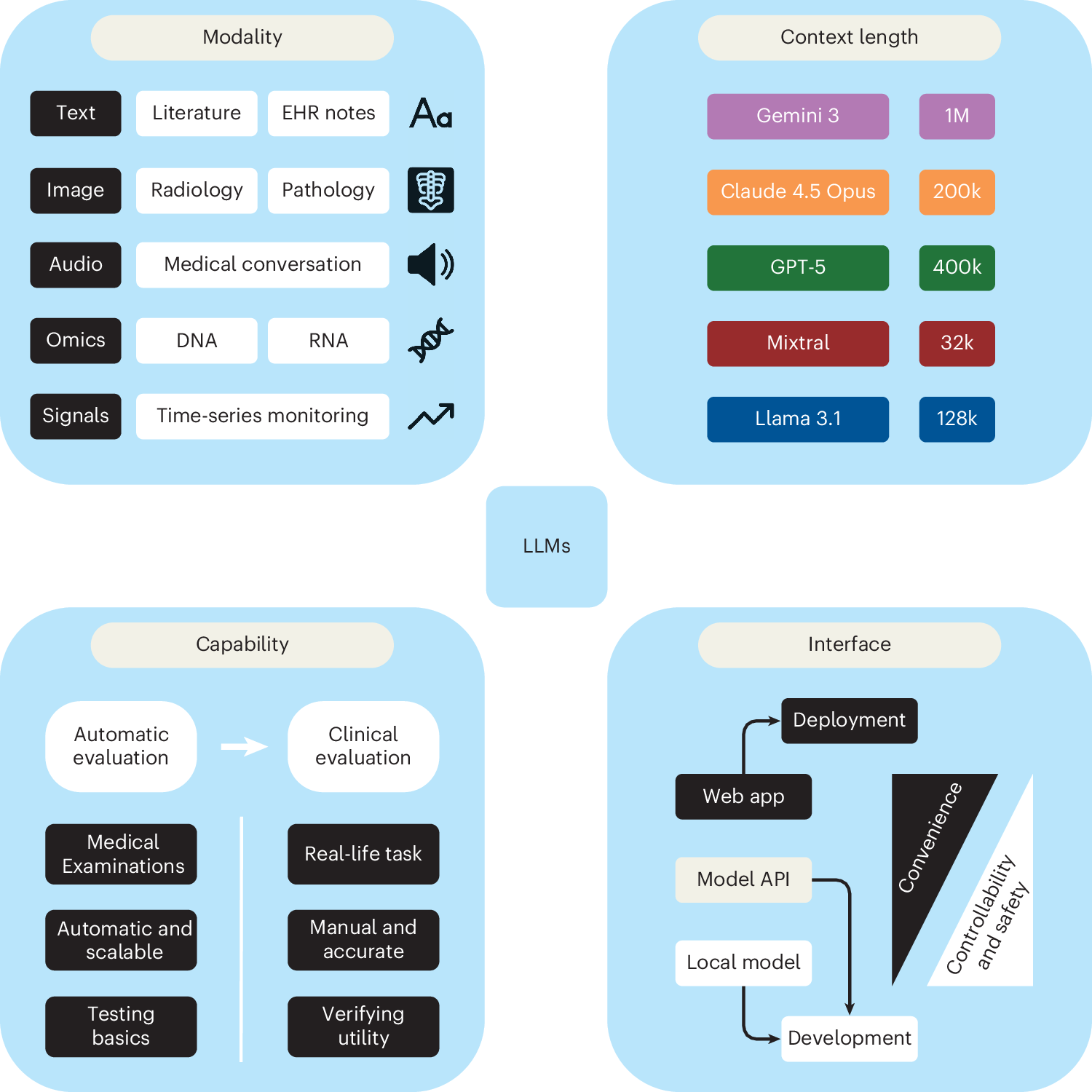
Selecting a model requires navigating trade-offs between model size, deployment constraints, performance, and compliance. The three key considerations are:
- Task & Data Modality: Determine if you require text-only capabilities (e.g., o3-mini, Llama 3) or natively multimodal models (e.g., Gemini 3, GPT-5, Claude 4.5) to process scans or omics data. Additionally, context length is a hard constraint: processing a patient’s entire longitudinal EHR history or multiple PubMed papers requires a long-context window (e.g., Gemini’s 1M-2M tokens).
- Performance Requirements: Automatic benchmarks (e.g., MedQA-USMLE multiple-choice scores) serve as initial screens, but clinical utility must be verified via human-expert rubric evaluations. Larger frontier models generally exhibit superior reasoning but require more resources.
- Model Interface & Compliance:
- Web Apps: Chatbots (e.g., ChatGPT) are easy to use but lack reproducibility controls (such as temperature adjustment) and are generally not HIPAA-compliant for raw patient data.
- APIs: Cloud APIs (e.g., Azure OpenAI, Anthropic API) allow programmatic control, and many offer BAA (Business Associate Agreement) options for HIPAA compliance.
- Local Implementations: Open-weights models (e.g., Llama 3.1, Qwen3, DeepSeek-R1) hosted on private institutional hardware provide the highest degree of security, data privacy, and parameters customizability.
The table below outlines the characteristics of commonly used LLMs, sorted by their reported MedQA-USMLE performance:
| LLM | Weights | Size | Interface | Modality | Context | MedQA |
|---|---|---|---|---|---|---|
| GPT-5 | Closed | NA | Web, API | T, I | 400k | 95.8%109 |
| o1-preview | Closed | NA | Web, API | T | 128k | 94.9%58 |
| Gemini 3.0 Pro | Closed | NA | Web, API | T, I, V, A | 1M | 94.6%110 |
| o3-mini | Closed | NA | Web, API | T | 200k | 92.7%59 |
| Gemini 2.5 Pro | Closed | NA | Web, API | T, I, V, A | 1M | 92.6%111 |
| DeepSeek-R1 | Open | 671B | Web, API, Local | T | 128k | 92.0%59 |
| Claude 4.5 | Closed | NA | Web, API | T, I | 200k | 91.4%110 |
| Med-Gemini | Closed | NA | Web, API | T, I, V, A | 1M, 2M | 91.1%9 |
| GPT-4 | Closed | NA | Web, API | T, I | 8k, 32k, 128k | 90.2%14 |
| Llama 3.1 | Open | 8B, 70B, 405B | API, Local | T | 128k | 88.2%112 |
| Qwen3 | Open | 0.6B, 1.7B, 4B, 8B, 14B, 30B, 32B, 235B | Web, API, Local | T | 32k, 262k | 87.4%113 |
| Med-PaLM 2 | Closed | NA | API | T | 8k | 86.5%34 |
| Llama 3 | Open | 8B, 70B, 405B | API, Local | T | 8k | 80.9%81 |
| GPT-3.5 | Closed | NA | Web, API | T | 4k, 16k | 68.7%114 |
| Med-PaLM | Closed | 540B | API | T | 8k | 67.6%15 |
| Gemini 1.0 | Closed | NA | Web, API | T, I, V | 32k | 67.0%115 |
| Mixtral | Open | 8x7B | API, Local | T | 32k | 64.1%81 |
| Mistral | Open | 7B | API, Local | T | 8k, 32k | 59.6%81 |
| Llama 2 | Open | 7B, 70B | API, Local | T | 4k | 47.8%81 |
3. Prompt Engineering Best Practices for Medicine
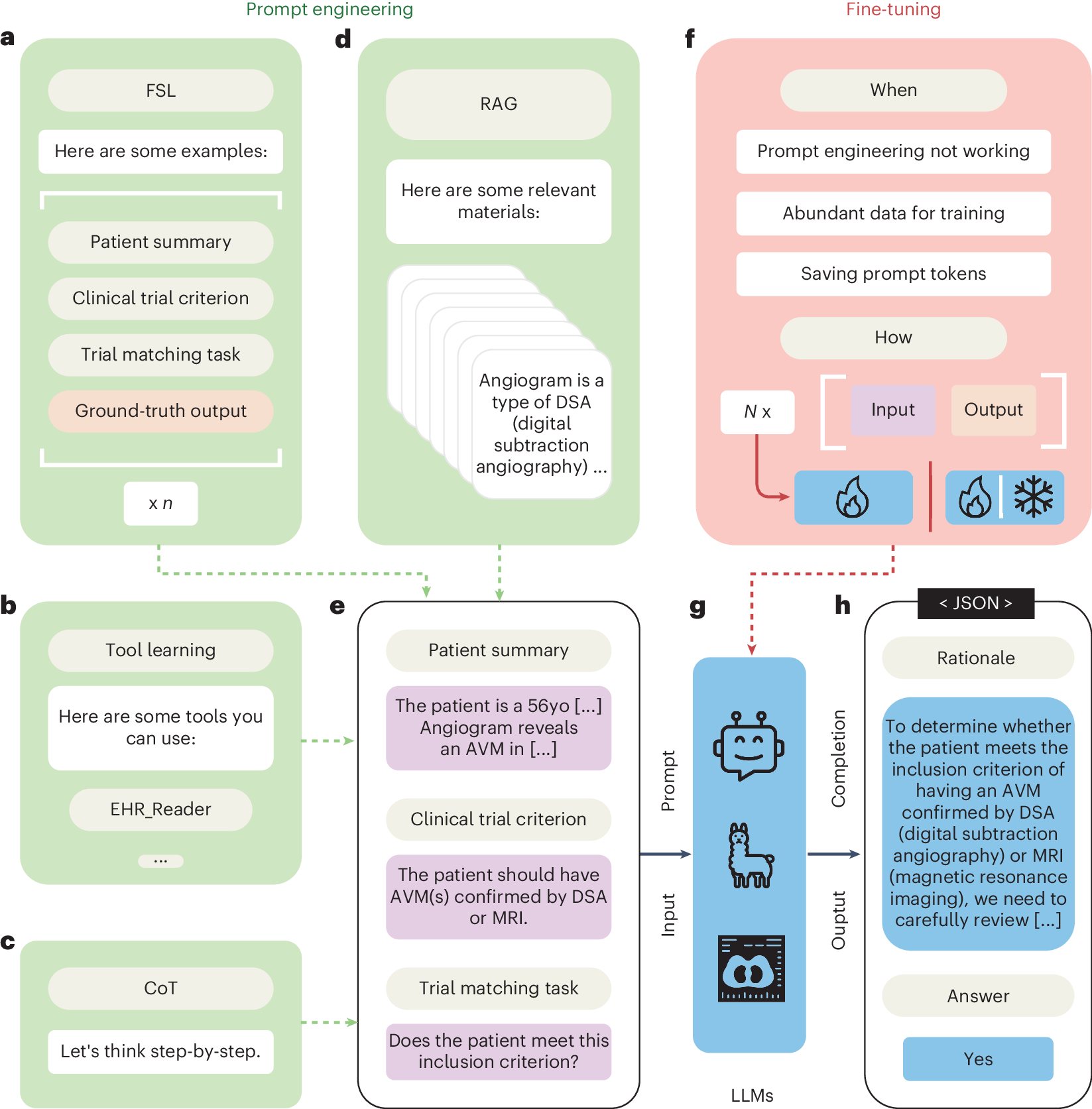
Designing and optimizing the prompt allows you to steer the behavior of a pre-trained LLM without updating its weights. The tutorial details five core prompt engineering techniques:
A. Few-Shot Learning (FSL)
Providing 1 to 5 diverse, representative examples of inputs and ground-truth outputs within the prompt. This clarifies the expected response style and instructs the model on how to handle edge cases.
B. Chain-of-Thought (CoT) Prompting
Instructing the model to generate a step-by-step rationale before generating the final answer (e.g., appending “Let’s think step-by-step” or using native reasoning models like DeepSeek-R1). CoT improves accuracy on complex multi-step reasoning tasks and provides an auditable logic path for clinicians.
C. Retrieval-Augmented Generation (RAG)
Integrating an external search tool (e.g., querying PubMed or institutional guidelines) to retrieve relevant text snippets and inject them into the prompt. This grounds the LLM’s responses in factual, up-to-date literature, significantly reducing hallucinations.
D. Tool Learning
Enabling the model to recognize when calculations or data retrieval are needed and call external APIs (e.g., medical calculators or database queries) to fetch precise values.
E. Reproducibility Settings
When performing clinical evaluations, set the model temperature to 0 and request JSON formatting. This ensures the output is deterministic, reproducible, and easily parsed by downstream code.
4. Fine-Tuning: When and How?
When prompt engineering fails to meet clinical requirements, or when prompts become too long and costly, researchers should consider fine-tuning the model.
- When to Fine-Tune: When you have abundant annotated domain data (typically >1,000 instances), when task-specific style is highly complex, or when you need to optimize a smaller model (e.g., a 7B or 8B model) to run locally on resource-constrained hardware.
- How to Fine-Tune: Standard approaches include full-parameter tuning and Parameter-Efficient Fine-Tuning (PEFT). Techniques like LoRA (Low-Rank Adaptation) and its quantized version (QLoRA) freeze the base model and train only a tiny fraction of adapter parameters. QLoRA dramatically reduces hardware requirements, enabling researchers to fine-tune clinical-grade models on a single commercial GPU (e.g., NVIDIA A100 or RTX 8000).
The table below contrasts the requirements, pros, and cons of these different approaches:
| Approach | Requirements | Pros | Cons | Examples |
|---|---|---|---|---|
| FSL | Several exemplars | (1) Dealing with edge cases; (2) specifying expected styles | Exemplars might introduce biases | MedPrompt14 |
| Tool learning | Application programming interfaces | Providing domain functionalities | Relies on the curation of tools | GeneGPT86, GeneAgent87, EHRAgent89, ChemCrow116 |
| CoT prompting | Additional prompt text (‘Let’s think step-by-step’) | (1) Providing explanations; (2) improving performance | Hard to parse (mitigated by structured output) | MedPrompt14 |
| RAG | A knowledge base or document collection | (1) Providing up-to-date knowledge; (2) reducing hallucinations | Depends on the quality of the retrieved documents | Almanac117, MedRAG81 |
| Fine-tuning | Data annotations and compute | (1) Improving performance; (2) shorten the prompt | Full-scale fine-tuning can be costly and resource intensive | MEDITRON57, PMC-LLaMA56 |
5. Deployment, Costs, and Safety Considerations
Bringing an LLM application into clinical production requires addressing severe safety, regulatory, and financial concerns:
A. Privacy and Regulatory Compliance
Patient data is protected by strict regulations such as HIPAA (in the US) and GDPR (in the EU). Uploading protected health information (PHI) to commercial APIs without an explicit Business Associate Agreement (BAA) is a severe breach of compliance. Best practice dictates deploying local models inside the institution’s secure private cloud or using certified HIPAA-compliant cloud hosting.
B. System Robustness and Bias
LLMs can inherit and propagate biases present in their training corpora. Studies have shown that models can output different treatment recommendations when presented with identical patient clinical summaries where only the patient’s race or gender is altered. Prior to deployment, researchers must evaluate model fairness using benchmarks (e.g., TrustLLM, DecodingTrust) or expert panels.
C. Financial Costs
- Proprietary Models: Charged per token. For instance, processing 1,000 discharge notes (approx. 4 million tokens) through Gemini 3.0 Pro costs about $8 for prompt tokens, with additional charges for completion tokens. This pricing can scale rapidly.
- Open-Source Local Models: Incur upfront hardware procurement (GPUs) and ongoing maintenance costs. Smaller models (8B) can run on a single GPU, while larger reasoning models (e.g., DeepSeek-R1 671B) require multi-GPU cluster configurations.
D. Post-Deployment Monitoring
LLMs must be treated as decision-support systems, not replacements for human clinical judgment. Successful deployment requires active clinician training, patient panel feedback, and continuous monitoring for drift, bias, and performance decay as the clinical setting evolves.
| Study | Task Formulation | LLM(s) Selection | Technique | Evaluation |
|---|---|---|---|---|
| Van Veen et al.21 | Summarization | FLAN-T597, Llama, etc | FSL, fine-tuning | Automatic and manual evaluation of summaries |
| Singhal et al.15 | Knowledge and reasoning | Med-PaLM | FSL, CoT prompting, fine-tuning | MCQ evaluation and manual evaluation of answers |
| Wang et al.48 | Structurization | Llama | Fine-tuning | Automatic classification evaluation and manual error analysis |
| Mirza et al.47 | Translation | GPT-4 | Direct prompting | Manual evaluation of clinical translation by domain experts |
| Zhang et al.118 | Multimodality | BiomedGPT118 | Fine-tuning | MCQ evaluation and manual evaluation of visual tasks |
Summary: The 10 Best Practices
For quick reference, here are the ten key takeaways mapped out in the Nature Protocols tutorial:
- Classify your task into one of the five core categories and compile ~100 diverse test instances.
- Ensure HIPAA/GDPR compliance when processing sensitive patient data.
- Align your choice of LLM with the required data modalities and context window.
- Screen models using expert clinical evaluations in literature rather than automatic benchmarks.
- Use Few-Shot Learning (1–5 shots) to specify expected styles and resolve edge cases.
- Default to Chain-of-Thought prompting (asking the model to “think step-by-step”) to improve reasoning.
- Ground the model with RAG or Tool Learning to reduce hallucinations and access external databases.
- Set temperature to 0 and request JSON output for reproducibility and automated parsing.
- Consider PEFT/LoRA fine-tuning when prompt engineering is insufficient or token costs are prohibitive.
- Implement continuous post-deployment monitoring for bias, drift, and clinical safety.
Code Availability
For researchers looking to implement these protocols, the NCBI team has made their tutorial code, prompt templates, and step-by-step scripts publicly available on GitHub:
👉 ncbi-nlp/LLM-Medicine-Primer
References
- Jin, Q., Wan, N., Leaman, R., et al. (2026). “Tutorial: guidance on the use of large language models for medical research.” Nature Protocols, doi:10.1038/s41596-026-01408-z.
- Van Veen, D., et al. (2024). “Adapted large language models can outperform medical experts in clinical text summarization.” Nature Medicine, 30, 1134–1142.
- Singhal, K., et al. (2023). “Large language models encode clinical knowledge.” Nature, 620, 172–180.
- Wang, H., et al. (2024). “DRG-LLaMA: tuning LLaMA model to predict diagnosis-related group for hospitalized patients.” npj Digital Medicine, 7, 16.
- Mirza, F. N., et al. (2024). “Using ChatGPT to facilitate truly informed medical consent.” NEJM AI, 1, AIcs2300145.
- Zhang, K., et al. (2024). “A generalist vision–language foundation model for diverse biomedical tasks.” Nature Medicine, 30, 3129–3141.
Enjoy Reading This Article?
Here are some more articles you might like to read next:
- $1.8 Billion for AI-Ready Biology: A Bioinformatician's Take on the Virtual Biology Initiative Expansion
- Rethinking Bioinformatics Expertise in the Era of AI: A Newbie's Journey as a Custodian
- Mapping the Global Landscape of Cancer Research: Key Trends from the Nature Index
- Shattered Chromosomes: Understanding Chromothripsis and Genome Rearrangement Models
- Diffusion LLMs
- Nanopore raw data visualization using squigualiser
- Nanopore direct RNA data analysis using Dorado
- Modern commnad line tools powered by Rust
- Nanopore direct cDNA data analysis
- Hi-C data analysis